AI Website Builder vs Developer: The Real Difference in 2026
March 29, 2026 | By Krishna Tupe
Krishna is the CTO of The Scaling Point and a Web Developer & SEO expert with 5+ years of UI/UX experience. He specializes in building technical architecture that dominates search rankings and converts traffic at scale.
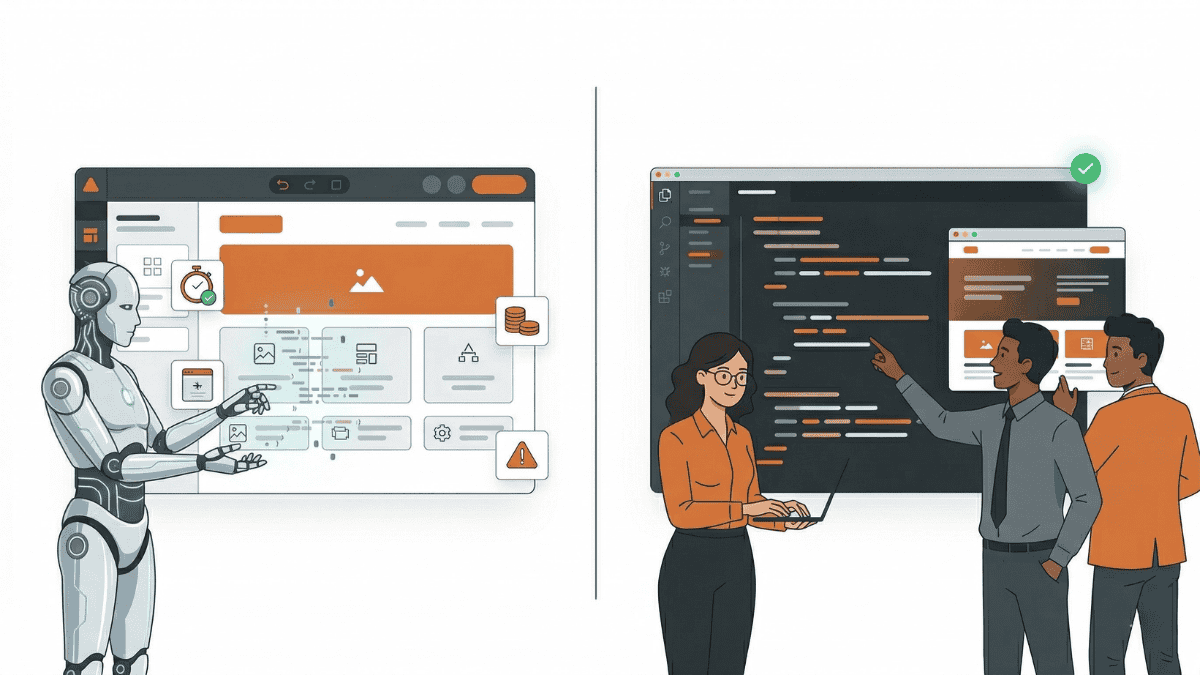
The AI website builder market crossed $2.32 billion in 2025 and it's not hard to see why. Tools like Framer, Wix Vibe, Lovable, and Hostinger Horizons can spin up a professional-looking website in under 30 minutes. For a founder already juggling a business, that sounds like exactly what you need.
And if all you want is something that looks the part? They deliver. But here's what those headline features don't tell you: a website that looks good and a website that performs are two different things. One sits there. The other brings in leads, ranks on Google, and pays for itself.
This post gives you the honest comparison what AI builders genuinely do well, where they cap out, and exactly when it makes financial sense to bring in a professional developer instead. Read the full breakdown in our Website Conversion Guide for Service Businesses.
Key Takeaways
- AI builders can launch a polished site in under 30 minutes for as little as £10–£40/month but sites loading in 1 second convert at 3x the rate of those loading in 5 seconds (Portent, 2022).
- Only 51.8% of websites currently pass Google's Core Web Vitals a number that drops sharply for AI builder platforms running on shared infrastructure (Chrome UX Report, June 2025).
- For businesses where the website is a revenue channel, the performance, SEO architecture, and conversion design you get from a professional build aren't a luxury they're the foundation everything else runs on.
What AI Website Builders Actually Get Right in 2026
Let's be honest about this: AI builders have come a long way. The gap between a Framer site and a custom-built one was far wider in 2022 than it is now. In 2026, the best AI tools produce layouts that are genuinely responsive, visually clean, and mobile-first by default. You don't need to know HTML to end up with something that doesn't embarrass you.
The speed advantage is real. A project that would take a design team 15–20 hours to produce from scratch wireframes, design, revisions, build an AI builder can deliver in under 30 minutes. For a pre-revenue startup testing an idea, or a campaign landing page that needs to go live this week, that speed is genuinely valuable.
Cost is another honest win. AI builder subscriptions start at around £10–£40/month. If you're in the early stages and haven't validated your offer yet, spending thousands on a custom build before you know it'll convert would be a mistake. AI tools make a fast, low-cost proof-of-concept possible for almost anyone.
They also include the basics of SEO title tag fields, meta descriptions, sitemaps, and in some cases, even basic schema. For low-competition local searches, some AI builder sites do rank. And newer tools like Hostinger Horizons have started adding code export features, giving founders at least some control over portability.
So yes if you're testing an idea, validating a landing page, or building a brochure site for a business that isn't web-dependent, an AI builder can absolutely do the job. The problems start when you need the site to do more.
Where AI Websites Hit the Ceiling The Performance Gap
Sites loading in 1 second achieve conversion rates of 3.05% on average that number drops to just 1.08% at 5 seconds. That isn't a marginal difference. For a service business generating £30,000/month in revenue, that gap could represent tens of thousands in annual lost revenue from load time alone.
AI builders run on shared hosting infrastructure. Your site sits alongside thousands of others on the same server, competing for the same resources. The code output is often bloated AI tools generate everything from the same component library, including styles and scripts you'll never use. The result is inflated page weight, slower rendering, and Core Web Vitals scores that frequently sit well below Google's thresholds.
To put this in numbers: Google's data shows that when page load time increases from 1 to 5 seconds, bounce rate probability jumps by 90% (Google Consumer Insights). And only 51.8% of websites currently pass all three Core Web Vitals a number that drops significantly for sites built on drag-and-drop platforms with no control over the underlying code.
A custom-built site, by contrast, gives the developer full control over what loads, when it loads, and how it's delivered. That means choosing the right hosting stack, optimising images properly, eliminating unused scripts, and targeting the exact Core Web Vitals thresholds that Google uses as ranking signals. The performance gap between a well-built custom site and an average AI builder output isn't cosmetic it's fundamental.
A site that loads in 1 second achieves a conversion rate of 3.05% compared to just 1.08% for a site that takes 5 seconds, according to Portent's page speed study (2022). This nearly 3x conversion gap means that for a service business turning over £30,000/month, a single second of load time improvement could represent thousands in additional monthly revenue.
Can an AI Website Actually Rank on Google?
AI builders come with basic SEO tools you can set title tags, write meta descriptions, and generate a sitemap. For hyperlocal searches with almost no competition, some AI sites do show up. But ranking in any contested space requires more than settings panels. It requires infrastructure.
Here's what most AI builders can't do properly: structured data. Schema markup the JSON-LD code that tells Google (and AI Overview) exactly what your page contains is either absent or severely limited on most builder platforms. Without Article schema, FAQ schema, and BreadcrumbList at minimum, your content is invisible to many of the rich result types that now dominate the SERPs.
Then there's the JavaScript rendering problem. AI crawlers from Google, OpenAI, and Perplexity don't execute JavaScript the same way a browser does. If your AI builder renders content client-side which many do the content those crawlers index is incomplete. That's a significant disadvantage in a world where 50%+ of Google queries now trigger an AI Overview (Search Engine Land, 2025).
What we see in the field: When we audit service business websites built on AI platforms, we consistently find three problems: no structured data beyond basic metadata, client-rendered JavaScript blocking AI crawler access, and heading hierarchies that skip levels all of which compound each other's negative impact on both rankings and AI citation probability.
Platform lock-in is a related problem that doesn't get enough attention. If you build on an AI platform and later want to move to a custom stack whether for performance, features, or ownership you can't simply export your code and go. Most platforms don't allow that. You're rebuilding from scratch, losing any domain authority you'd accumulated, and disrupting the URL structure your existing backlinks point to.
In 2025, more than 50% of Google searches now trigger an AI Overview a result type that pulls from pages using structured data and server-side rendered content. AI website builders, which typically lack full schema markup support and rely on client-side JavaScript, are structurally disadvantaged for this rapidly growing share of search visibility.
Learn more about SEO and organic growth for scaling businesses.
UI and UX: What's the Difference, and Why Does It Matter for Your Revenue?
A visitor decides whether to stay on your website in 0.05 seconds (Nielsen Norman Group). That's how fast first impressions form before they've read a word. AI builders understand this, which is why their outputs look polished. Clean layouts, consistent typography, acceptable whitespace. The UI is fine.
But UI (user interface) and UX (user experience) are different things. UI is what something looks like. UX is whether it works whether it moves the right person toward the right action at the right moment. AI builders are trained on popular design patterns, which means they generate layouts that look like the average of what everyone else is already doing. There's no buyer psychology behind it. No analysis of where your specific audience loses trust, hesitates, or needs reassurance before they'll act.
A well-designed UX can increase conversion rates by up to 400% (McKinsey & Company). That gap doesn't come from picking a nicer colour palette. It comes from understanding the journey from Click → Trust → Action: what the visitor is worried about when they land, what proof they need before they'll enquire, and where the CTA needs to sit so it lands at the moment they're ready not before, and not after.
AI Website Builder vs Developer-Built: Side-by-Side
| Dimension | AI Builder | Developer-Built (TSP) |
|---|---|---|
| Speed to launch | ✓ | Longer lead time |
| Mobile responsiveness | ✓ | ✓ |
| Visual design quality | Template-based | ✓ Custom to brand |
| Conversion copywriting | ✗ | ✓ Strategy-led |
| Core Web Vitals performance | ✗ | ✓ |
| Full schema markup (SEO/GEO) | ✗ | ✓ |
| Scalability | Platform cap | ✓ Unlimited |
| Custom integrations (CRM, etc.) | Add-on cost | ✓ |
| Code ownership | ✗ Platform owns it | ✓ You own it |
The Scaling Point analysis, March 2026.
The insight competitors miss: An AI builder creates a website for the person who built it. A strategy-first developer builds a website for the person who lands on it. That distinction designing around your buyer's journey rather than your own preferences is what separates a site that converts from a site that just sits there.
Maintenance, Hosting, and Tech Stack: The Hidden Complexity Nobody Talks About
Most comparison articles focus on launch day. Here's what happens after you launch.
When you build on an AI platform, the platform owns the infrastructure. Your site lives on their servers, runs on their code, and depends on their continued operation. That's not inherently bad until pricing changes, features get removed, or you outgrow what the platform allows. What starts at £10/month often scales to £80–£150/month once you add the e-commerce features, custom domains, advanced analytics, CRM integrations, and priority support you actually need to run a serious business.
Portability is a real issue. Most AI builder platforms don't give you access to the underlying source code. If you decide to move to a faster host, a different CMS, or a custom stack you're starting from scratch. That means rebuilding the site, re-establishing any link equity you've built, and disrupting the URL structure that existing content and backlinks point to.
Security and updates are managed by the platform, not by you. That's convenient until there's a vulnerability in the platform's shared infrastructure that affects every site running on it. With a professionally built site on managed hosting, your developer controls the update schedule, applies patches on your timeline, and can isolate your environment entirely.
And as your business scales, integration complexity grows fast. Custom CRM workflows, booking engines, payment processing, lead routing, and email automation that work the way your business actually works not the way the platform's marketplace add-on works require code access that AI builders simply don't provide.
AI builder platforms own the hosting, code, and infrastructure of your website meaning pricing changes, feature removals, and platform migrations are entirely outside your control. A professionally built site means you own your stack, choose your hosting, control your costs, and can migrate freely without rebuilding from the ground up.
So Which One Do You Actually Need? The Honest Decision Framework
The answer isn't "developers always win." It depends on what you're building and what it needs to do. Here's how we think about it with every client who asks us this question.
Use an AI builder if:
- You're testing an idea before you've validated demand
- You need a landing page live by the end of the week for a single campaign
- The site is not a primary revenue channel it's a brochure
- You're working with a budget under £500 and not running paid ads
- You expect to rebuild properly once you've got traction
Get a professionally built site if:
- Your website is how you generate leads, bookings, or enquiries
- You're running paid ads and need a funnel that converts the traffic
- SEO and AI search visibility matter to your growth strategy
- You need custom integrations CRM, booking, payments, automations
- You've outgrown templates and your site no longer reflects the business you're running
- You're doing £10k+/month and your website is the weakest link in your sales process
Across the website audits we run for new clients, poor conversion architecture unclear messaging, missing trust signals, no logical flow toward a CTA is the most common revenue leak we find. Not the design. Not even the speed. The strategy underneath the design. That's what's missing most often, and it's what no AI builder can provide.
How The Scaling Point Builds Websites That Actually Convert
We're not anti-AI. We use AI tools throughout our process. But we build websites with strategy first and strategy isn't something you can generate in 30 minutes from a prompt.
Every build at The Scaling Point follows the same process: Funnel Mapping before any design starts. We map the complete journey from Click → Trust → Action before we wireframe a single page. Who is this person? What are they worried about? What do they need to see before they'll pick up the phone or fill out the form?
That thinking shapes everything the structure, the copy, the placement of social proof, the CTA. Wireframes and copy are built around that journey, not around aesthetic preferences. Then the design and build follows: mobile-first, fast, and clean. SEO and GEO optimised from day one Article schema, FAQ schema, BreadcrumbList, server-side rendering so every crawler (Google, OpenAI, Perplexity) can read the full content. Custom hosting stack, not shared infrastructure.
We also set up everything around the build CRM forms, lead routing, email capture, and automation flows so the traffic you bring in actually goes somewhere. If you're running paid ads, your funnel needs to convert at every step, not just look good on the landing page.
If your current website doesn't reflect the quality of the business you're running or if you're investing in ads or SEO and not seeing the return you expected the website is usually the reason.
See our approach to conversion-focused website builds.
Frequently Asked Questions
Can an AI website builder rank on Google?
AI builders include basic SEO settings title tags, meta descriptions, and sitemaps which is enough to rank in very low-competition local searches. But competitive ranking requires technical SEO infrastructure: structured data, server-side rendering, clean heading hierarchy, and proper Core Web Vitals scores. Only 51.8% of websites pass all three Core Web Vitals (Chrome UX Report, June 2025), and AI builder sites on shared infrastructure typically perform below this threshold. For SEO to be a real growth channel, the technical foundation needs to be right from the start.
How much does a professionally built website cost versus an AI builder?
AI builders cost £10–£150/month depending on features low upfront, but the cost compounds over time as you add the tools a growing business actually needs. A professionally built site is a one-time project investment, typically starting from £2,000–£5,000 for a service business and scaling based on scope and complexity. For businesses using the website to generate leads or book clients, the professional build usually pays for itself within the first few months if the conversion architecture is right.
Is Wix or Framer good enough for a business doing £10k+/month?
Honestly it depends on what the site needs to do. If it's a brochure with minimal traffic, possibly. But if your website is where you generate enquiries, if you're running paid ads to it, or if SEO is part of your growth strategy, the performance gaps and schema limitations of builder platforms will cost you. At £10k/month, your website should be one of your hardest-working assets not a liability.
What actually makes a website "conversion optimised" versus just well-designed?
Design is what the site looks like. Conversion optimisation is whether it works whether the right visitor takes the right action at the right moment. That requires understanding your buyer: their objections, the proof they need, where trust breaks down, and how the CTA needs to land. A well-designed UX can increase conversions by up to 400% (McKinsey), but that uplift comes from strategy, not aesthetics.
How long does a professional website build take with The Scaling Point?
Timelines depend on scope, but most service business websites and funnels are delivered within 4–8 weeks from brief to launch. The process starts with funnel mapping and strategy before a single page is wireframed so by the time the build starts, every decision is already backed by clear thinking about your audience and goals. We stay in close communication throughout, with no surprises and no endless revision cycles.
The Bottom Line
AI website builders have genuinely earned their place. For testing an idea, launching an MVP, or putting up a simple brochure, they're a smart, fast, cost-effective choice. Don't let anyone tell you otherwise.
But for a business where the website is a revenue channel where leads, bookings, and client enquiries flow through it every week performance, SEO architecture, conversion design, and the strategy underneath the design are non-negotiable. That's not something you get from a template builder, however good the AI has become.
If your current site doesn't feel like it reflects the business you're running, or if you're driving traffic and it's not converting, the website is almost always where the problem lives.
Ready to build a website that actually converts?
Let's talk about your project and see if we're the right fit.
Book a Discovery Call →